


Views: 0 Author: Site Editor Publish Time: 2026-04-12 Origin: Site


Designing a skyscraper tests the absolute limits of engineering and project economics. Developers constantly battle to balance ambitious architectural visions against extreme wind and seismic loads. Choosing construction materials goes far beyond basic structural mathematics. Material selection dictates heavy foundation costs, rigid construction timelines, and long-term asset compliance. Relying on outdated methods often compromises your net leasable area and strains the overall development budget.
We will explore how modern urban development leverages specialized metallurgy to build taller, safer, and faster. You will learn exactly why a profitable High-Rise Steel Structure Building depends on highly tailored steel grades, advanced framing configurations, and optimized physical properties. This comprehensive guide breaks down the essential criteria every stakeholder needs to evaluate before breaking ground on a major commercial tower.
Grade Selection: Structural high-rises depend heavily on high-strength, low-alloy (HSLA) steels (e.g., A572, A992) rather than standard carbon steel, prioritizing the strength-to-weight ratio.
System Optimization: Taller structures shift from simple rigid frames to bundled tubes or outrigger systems to manage lateral forces efficiently.
Commercial Yield: Utilizing high-strength steel reduces column cross-sections, directly increasing net leasable square footage.
Total Cost of Ownership (TCO): Steel framing significantly reduces structural dead weight (lowering foundation costs) and accelerates erection schedules, offsetting potentially higher raw material costs compared to concrete.
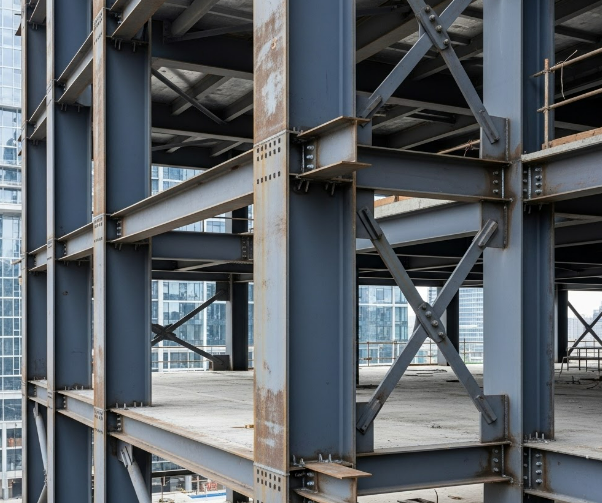
Standard mild steel simply cannot handle primary vertical load-bearing duties in skyscrapers. Engineers rigorously evaluate materials using three primary metrics. Yield strength marks the exact point of permanent, irreversible deformation. Tensile strength indicates the ultimate breaking threshold under extreme stress. Elongation measures ductility, showing how much the material can stretch before failing. Standard carbon steel like A36 lacks the necessary yield strength for supertall applications, forcing structural engineers to specify advanced alternatives.
You must turn to High-Strength Low-Alloy (HSLA) steels to support massive vertical loads. ASTM grades A572 and A992 serve as strict industry benchmarks. They provide exceptional yield strength, typically exceeding 50,000 psi. We use them extensively for main support columns and critical interconnecting beams. For even taller structures, engineers specify high-performance steels like S355 and S460. Upgrading to these advanced grades significantly reduces total material volume. This strategic reduction trims overall dead weight and lowers heavy shipping costs.
Steel Grade | Typical Yield Strength | Primary High-Rise Application |
|---|---|---|
ASTM A36 | 36,000 psi | Secondary elements, non-load-bearing brackets, and minor bracing. |
ASTM A992 | 50,000+ psi | Main support columns, W-beams, and primary floor framing. |
High-Performance S460 | 66,000+ psi | Supertall structures, heavy load transfer beams, and lower-floor core columns. |
Modern skyscrapers also rely heavily on advanced metallurgical approaches. The Thermo-Mechanical Control Process (TMCP) revolutionized architectural steel manufacturing. Controlled rolling minimizes the critical yield-to-tensile ratio. It creates a dense, highly uniform microstructure. This process prevents brittle fractures, acting as a crucial requirement in active seismic zones. Furthermore, microalloying solves historical engineering trade-offs. Adding trace elements like niobium drastically lowers the carbon content required for hardening. This simultaneous improvement boosts both yield strength and weldability, solving the traditional strength versus brittleness dilemma.
Raw material grades mean nothing until fabricators transform them into highly usable geometric shapes. Every skyscraper relies on specific structural profiles engineered for distinct load outcomes. Mapping raw metallurgy to actual manufactured shapes ensures safe delivery and assembly on the construction site.
Heavy-Duty H-Beams: We deploy these massive profiles deep inside structural foundations and lower-floor core framing. Manufacturers roll them with immense flange thickness. A single heavy-duty H-beam can safely support upwards of 1,000 tons of compressive load. They form the unbreakable root system of any major tower.
W-Beams (Wide Flange): These act as the undisputed standard for horizontal floor framing. W-beams interconnect long spans highly efficiently. They distribute floor weight evenly while maintaining a lean, weight-saving profile. Construction teams rely on them to link perimeter columns to the central core.
Thick-Wall High-Strength Tubes & CFT: Structural engineers heavily favor hollow structural sections (HSS) for supertall applications. They come in either square or circular hollow profiles. Often, construction teams pump them full of high-strength concrete to create Concrete-Filled Tubes (CFT). This hybrid approach provides incredible isotropic strength. It actively prevents thin steel walls from buckling under immense axial loads.
How you organize physical steel directly dictates the maximum safe height of your building. Framing solutions broadly categorize into base frameworks and advanced lateral systems. A well-designed High-Rise Steel Structure Building uses geometry to resist gravity, heavy wind shear, and unpredictable earthquakes.
For mid-rise commercial projects scaling up to 40 stories, engineers typically utilize base frameworks. These rely on fundamental geometric stability.
Rigid Frames: These systems utilize incredibly strong, moment-resisting beam-to-column connections. They maintain intersecting angles perfectly, even under severe bending forces. They work well for open floor plans but become inefficient at extreme heights due to lateral sway.
Braced Frames: These incorporate diagonal steel members across the vertical bays. They act like massive structural trusses. They intercept lateral wind forces and channel them efficiently straight down into the foundation.
Supertall and megatall buildings over 50 stories demand much more advanced lateral systems. These configurations manage incredible atmospheric forces.
Outrigger Systems: These mechanisms connect the rigid central elevator core to the outer perimeter columns. They utilize massive horizontal steel trusses to dramatically reduce sway. They act like ski poles, widening the stance of the tower and improving overall passenger comfort during high winds.
Framed-Tube and Bundled-Tube Systems: These designs create a rigid, pipe-like exterior grid. Columns sit very close together on the perimeter. The Willis Tower in Chicago famously pioneered this bundled-tube logic. It maximizes structural efficiency and wind resistance without cluttering the interior footprint with massive support columns.
Transfer Beam Systems: Modern urban development often involves complex hybrid buildings. Developers routinely place residential apartments above wide-open commercial lobbies or ground-floor schools. Transfer beam systems shift massive load paths safely over these large, column-free spaces. They ensure heavy upper floors do not crush the open architectural voids below.
Financial stakeholders must prioritize Net Leasable Area (NLA) maximization. High-strength steel columns consume far less interior space than heavily reinforced concrete pillars. Thinner steel columns directly add highly valuable, sellable square footage to every single floor. Over a 60-story commercial tower, this distinct spatial efficiency generates massive long-term leasing revenue.
Foundation and soil economics also tilt heavily in favor of steel construction. A typical steel floor framing system weighs roughly 50 pounds per square foot. Comparable reinforced concrete systems often exceed 100 pounds per square foot. This drastic 50% weight reduction aggressively slashes foundation requirements. It shrinks the size of necessary concrete caissons and footings. This weight advantage makes ambitious mega-projects financially viable on soft soils or highly constrained urban plots.
Speed of delivery completely transforms project logistics and financing costs.
Erection Speed: Prefabricated structural components arrive on-site fully ready to assemble. Cranes lift them immediately into position. This process slashes expensive on-site labor hours and accelerates the journey to commercial occupancy.
Site Constraints: You can schedule precise steel deliveries in densely packed urban environments. This "just-in-time" logistics model avoids the continuous nightmare of queuing dozens of concrete trucks on busy city streets.
Weather Independence: Severe winter weather frequently halts wet concrete pouring. Concrete cannot cure properly in freezing temperatures. In stark contrast, steel erection proceeds safely and efficiently in harsh winter climates, preventing costly seasonal delays.
Every skyscraper faces critical environmental and construction vulnerabilities. You must identify and rigorously mitigate these risks during the early schematic design phase. Ignoring them invites catastrophic structural failure or severe regulatory penalties.
Seismic energy dissipation requires highly specialized materials. Engineers increasingly use Low-Yield-Point steel inside modern vibration-control dampers. This highly ductile steel undergoes deliberate plastic deformation during a major earthquake. It absorbs destructive kinetic energy safely, actively protecting the primary structural framework from tearing apart. Furthermore, suppliers must perform strict Charpy V-Notch impact testing on all structural materials. This swinging-pendulum test verifies material toughness. It guarantees the steel will not suffer catastrophic brittle failure when exposed to extreme low temperatures.
Fire compliance remains a strict, non-negotiable regulatory hurdle. Bare steel loses significant structural strength when exposed to high temperatures. Building codes classify modern high-rises as Type 1 construction, mandating rigorous non-combustible compliance. Developers apply thick layers of intumescent paint or use specialized fire-resistive encasements around critical beams. Intumescent coatings expand rapidly when heated, creating a thick, insulating char layer. These thermal barriers buy crucial time for occupant evacuation and first responder intervention.
Weldability introduces another layer of hidden risk on the construction site. Applying high-heat inputs to thick steel plates can severely degrade structural joints. This creates dangerous heat-affected zones (HAZ) where the metal becomes brittle. Fabricators mitigate this vulnerability using advanced narrow-gap welding techniques. Specifying optimal carbon equivalent (PCM) steels also prevents joint degradation. Low PCM steel handles high welding heat beautifully, ensuring the finished connections remain just as strong as the virgin beams.
Specifying materials for a commercial skyscraper requires deep strategic alignment across multiple disciplines. You cannot treat structural steel as a simple, one-size-fits-all commodity. Successful megaprojects align advanced metallurgical properties—like high yield strength and thermal weldability—with the specific structural framing system chosen for the site.
To maximize project ROI, stakeholders should implement the following steps. Engage structural engineers and specialized steel fabricators early in the schematic design phase. Run comprehensive cost-weight optimizations comparing S355 and S460 steel grades to identify the most efficient material mix. Finalize tight procurement strategies to lock in raw material costs early. Finally, implement rigorous third-party testing protocols to guarantee uncompromising seismic and fire compliance.
A: Steel offers superior strength-to-weight ratios compared to concrete. This significantly reduces overall building weight and lowers deep foundation costs. Steel components arrive prefabricated, which aggressively accelerates erection speed. Thinner steel columns also maximize your net leasable area. However, concrete often provides better acoustic mass and lower raw material unit costs.
A: Steel boasts extraordinary natural ductility. It bends under extreme stress without breaking. Engineers amplify this inherent safety using rigid frame connections and low-yield-point dampers. These specialized dampers absorb seismic kinetic energy by undergoing controlled plastic deformation. They actively protect the main load-bearing framework from catastrophic brittle failure.
A: Yes. Steel loses critical load-bearing strength when exposed to severe high temperatures. Building codes classify skyscrapers as Type 1 construction, requiring strict fireproofing measures. Contractors apply expanding intumescent paint or wrap major beams in fire-resistive encasements. These treatments insulate the metal and preserve core structural integrity during a fire.
A: They differ primarily in their yield strength. ASTM A36 offers a yield strength of 36,000 psi. We use it mainly for secondary, non-load-bearing elements. ASTM A992 delivers a minimum yield strength exceeding 50,000 psi. It serves as the undisputed industry standard for primary vertical support columns and major wide-flange floor beams.


