


Views: 0 Author: Site Editor Publish Time: 2025-08-29 Origin: Site


You see steel in the tallest buildings, particularly in high rise steel structures, because it is very strong. Steel is also flexible and lasts a long time. Every tall building uses steel for these reasons. Engineers pick steel because it is strong but not too heavy. Steel makes strong joints and allows people to design many shapes. The Burj Khalifa, Willis Tower, and Shanghai Tower all utilize high rise steel structures. These buildings are tall and safe even in bad weather.
Reason | Description |
|---|---|
Excellent Strength-to-weight ratio | Steel is strong but does not need much material. This saves money compared to concrete or stone. |
Strong Joints | Welded steel joints are very strong. This makes buildings safer and keeps them standing. |
Unlimited Design Possibilities | Steel can be shaped in many ways. This helps architects make cool designs and keep buildings strong. |
Great Durability | Steel buildings last longer than others. Steel does not crack or wear out fast. |
Environmentally Friendly | Steel can be recycled again and again. This helps the planet more than other materials. |
Steel is very strong for its weight. This lets us build tall buildings that are not heavy. Using steel saves money and uses fewer materials than heavier choices.
Steel can bend without breaking. This helps tall buildings stay safe in strong winds and earthquakes. It keeps people safe during bad weather.
Building with steel is much faster. Workers can put together steel parts quickly at the building site. This lowers work costs and makes the project finish sooner.
Steel lasts a long time and does not rust easily. It does not get moldy or attract bugs. If you take care of it, steel buildings can last over 100 years. This means you do not have to spend much on repairs.
Steel is good for the environment because it can be recycled many times. This cuts down on trash and helps keep building green.
Steel lets you reach new heights in high-rise construction. When you look at the tallest buildings in the world, you see how steel shapes the skyline. You find steel in the frames, beams, and columns that support these tall structures. Steel gives you the strength and flexibility needed for skyscrapers. You can build higher and safer because steel resists bending and breaking.
You see many famous skyscrapers around the world. These buildings show what steel can do in high-rise construction. Here are some of the tallest buildings you might know:
Burj Khalifa in Dubai stands at 828 meters. Engineers used a concrete frame for most of the building, but steel played a key role in the spire and structural supports. The Burj Khalifa shows how steel and concrete work together to reach extreme height.
Shanghai Tower in China rises to 632 meters. Steel forms the main structure, letting the building twist and resist strong winds. The tower uses steel to keep its shape and stay safe.
Willis Tower in Chicago reaches 442 meters. This building uses a steel tubular-frame system. You see how steel lets the building stand tall and strong, even in windy conditions.
Merdeka 118 in Malaysia climbs to 678.9 meters. Steel supports the tower’s unique design and helps it resist earthquakes.
Empire State Building in New York stands at 381 meters. Steel made fast construction possible. Workers finished the building in just over a year.
Jeddah Tower in Saudi Arabia aims for over 1,000 meters. Steel will play a big part in the frame and core, helping the building reach new records.
You notice that steel is always present in the tallest high-rise buildings. Steel lets you build higher, faster, and safer than other materials.
When you compare steel-framed and concrete-framed skyscrapers, you see some differences in maximum achievable height:
Steel-framed buildings like the SFIA Matsen Tower can reach up to 48 stories. Cold-formed steel (CFS) shows strong potential for high-rise construction.
Concrete-framed buildings like the Burj Khalifa reach much greater heights, but steel remains essential for spires and special structural elements.
You might wonder which building holds the title of tallest steel-framed building. The Willis Tower in Chicago stands out. This skyscraper uses a steel tubular-frame system. The design lets you use less material while reaching great height. You see how steel makes the building strong and light at the same time.
Other notable steel-framed skyscrapers include the Empire State Building and the John Hancock Center. These buildings use steel to solve engineering challenges and reach new heights. You find steel in the beams, columns, and joints that hold everything together.
Here is a table showing how steel helps skyscrapers overcome tough engineering problems:
Skyscraper | Engineering Challenge | Notable Solution |
|---|---|---|
Goldin Finance 117 | Needed deep foundations in tricky soils | Used piles 100 meters deep, setting a world record |
Willis Tower | Wanted to reach new height with less material | Used a tubular-frame system with steel |
John Hancock Center | Needed to minimize steel usage while building tall | Used an innovative tubular-frame design |
Petronas Towers | Needed to keep two towers stable | Built a skybridge for extra support |
Taipei 101 | Needed to stop the building from swaying in the wind | Installed a tuned-mass damper |
Steel lets you solve problems that come with building tall structures. You can use less material and still keep the building safe. You see steel in the tallest steel-framed building and many other high-rise projects.
Steel offers many benefits for high-rise construction:
You get strong joints that keep the building stable.
You can shape steel into many forms, making creative designs possible.
You build faster because steel parts can be made ahead of time and put together quickly.
You enjoy long-lasting buildings because steel resists wear and corrosion.
When you look at products used in these buildings, you find steel beams, columns, and frames. These parts support the weight and keep the building safe. You see steel used in modular construction, which speeds up the building process. Steel makes it possible to build tall structures in less time.
Steel remains the top choice for high-rise construction. You see it in the tallest steel-framed building and many skyscrapers around the world. Steel gives you the strength, flexibility, and durability needed for tall structures. You can trust steel to support the world’s most impressive buildings.
Steel helps people build taller and safer buildings. You see steel in almost every modern skyscraper. It can hold a lot of weight but does not make the building too heavy. Steel lets builders make tall buildings that last a long time.
When designing skyscrapers, you want a strong but light material. Steel has the best strength-to-weight ratio of common materials. This means you use less steel but still hold more weight. Every tall building around the world uses this benefit.
Steel is easy to shape and recycle. You can make beams, columns, and frames from steel. These parts hold up the whole building.
If you compare steel to concrete and timber, steel is different. Concrete is good at handling pressure, but it is heavy and not flexible. Timber is light and grows back, but it cannot hold as much weight as steel in tall buildings.
Here is a table that shows how steel’s strength-to-weight ratio compares to other materials:
Material | Strength-to-Weight Ratio | Flexibility | Common Use in High-Rise Construction |
|---|---|---|---|
Steel | Highest | High | Frames, beams, columns |
Concrete | Moderate | Low | Floors, walls, cores |
Timber | Low | Moderate | Low-rise buildings |
Steel lets you build lighter but still safe and strong buildings. This matters for tall buildings, where every pound counts. You can build higher and use less material, which saves money and resources.
Some steel grades used in skyscrapers are IS 2062, ASTM A36, EN S275, and EN S355. These grades have yield strengths from 250 MPa to 355 MPa. Their tensile strengths range from 410 MPa to 630 MPa. You find these grades in the frames and supports of the tallest buildings.
Grade | Standard | Yield Strength (MPa) | Tensile Strength (MPa) | Common Applications |
|---|---|---|---|---|
IS 2062 | Indian Standard (BIS) | 250–350 | 410–580 | Structural steel, construction, fabrication |
ASTM A36 | ASTM (USA) | ≥ 250 | 400–550 | Buildings, bridges, and general structural use |
EN 10025 S275 | EN (Europe) | ≥ 275 | 410–580 | Construction, pipelines, structural work |
EN 10025 S355 | EN (Europe) | ≥ 355 | 470–630 | Heavy structures, offshore, transportation |
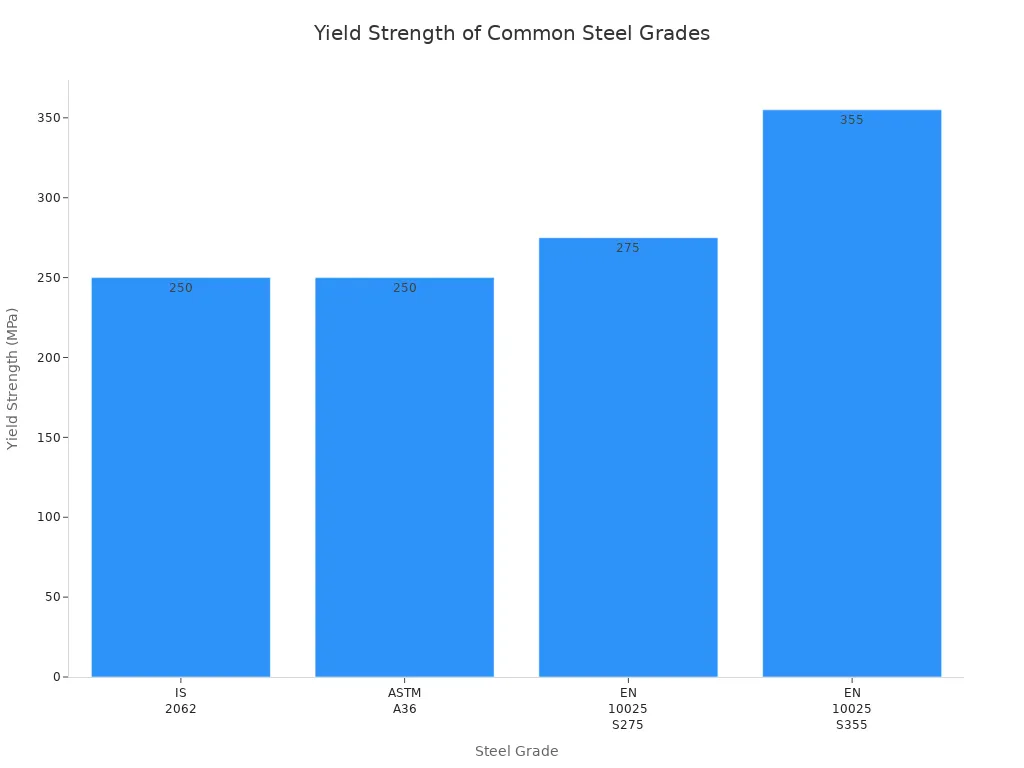
These steel grades help you build strong and safe tall buildings. You can trust steel to handle stress and keep the building stable.
Steel holds up the tallest skyscrapers in the world. You see steel frames in high-rise buildings because they keep the building steady and allow cool designs. Steel’s strength and flexibility let you build higher and safer than before.
Steel’s strength-to-weight ratio lets skyscrapers hold big loads but stay light. This is important for holding up the building and handling wind or earthquakes.
Engineers use steel to solve hard problems in tall buildings. You see steel in beams, columns, and joints that hold everything up. Steel does not bend or break easily, so the building stays safe during storms or earthquakes.
Steel can hold more weight than wood or concrete. Steel parts can carry big loads without making the building heavy. This matters in places where disasters can happen. Steel also does not burn or get eaten by bugs, so buildings last longer.
Here are some common tests and standards used to measure steel’s strength in high-rise applications:
Test Type | Description |
|---|---|
Tensile Test | Measures how much force a TMT bar can endure before fracturing, showing performance under tension. |
Bend Test | Checks ductility by seeing if TMT bars bend without cracking. |
Elongation Test | Shows how much a TMT bar can stretch before breaking, indicating ductility and stress absorption. |
ASTM E330 | Ensures steel windows can withstand strong wind pressures in high-rise buildings. |
These tests help engineers pick the right steel for each building. You get results that keep tall buildings safe and strong.
New technology has made steel even better for tall buildings. Here are some important changes:
The Bessemer process made steel cheaper and easier to make.
CAD and engineering software made building with steel more exact.
High-strength steel alloys let buildings hold more weight but stay light.
Seismic-resistant systems made skyscrapers safer during earthquakes.
Architects and engineers work together to use steel in smart ways. They use tools like Building Information Modeling (BIM) and computer design to test ideas and use materials better. Teams share data quickly to make fast choices and avoid mistakes.
Benefit | Description |
|---|---|
Efficiency | Teams work faster, speeding up decision-making and reducing delays. |
Cost-Effective | Early identification of issues reduces costly changes and optimizes material use. |
Quality | Unified teams ensure high standards in design and structure, improving safety. |
Sustainability | Collaboration leads to energy-efficient designs and sustainable materials, reducing environmental impact. |
Steel’s quality and international standards help keep tall buildings safe and lasting. Treated steel resists fire, bad weather, earthquakes, and rust. Coatings like galvanized or weathering steel stop rust, so you do not need much maintenance.
TMT bars help buildings handle earthquakes because they bend and absorb energy.
Steel does not burn easily, so it keeps buildings safe in fires.
Galvanized coatings stop rust, so buildings last longer.
When you look at the tallest buildings, you see how steel makes them possible. You get strong, flexible, and long-lasting buildings. Steel lets you build higher, safer, and faster than any other material.
You need a material that keeps tall buildings safe. Steel bends without breaking when strong winds blow. This lets the building move a little, like a tree in a storm. The movement helps stop damage and keeps the building steady.
Steel bends so skyscrapers can handle strong winds.
The building can move a few feet each way to stay safe.
This stops too much pressure from building up in one spot.
Engineers use machines to test steel frames during earthquakes. These tests show steel beams and columns can bend and stretch. Panel zones take in energy and help the building move without breaking. Steel buildings keep their shape even after big shakes.
Earthquake tests show steel frames form plastic hinges to spread out energy.
Steel frames with special systems move less and get less damage than others.
Using steel gives you safer and stronger tall buildings.
Steel lets you build skyscrapers that stand up to wind and earthquakes. You can trust steel to keep your building safe.
You want tall buildings to be safe from fire. Steel does not burn, but it gets weaker when it gets very hot. Building rules say you must protect steel from fire. People use special coatings or covers to keep steel safe in fires.
Fire Rating | Description |
|---|---|
2-hour | Parts of the building pass a 2-hour fire test. |
Building Codes | Rules for fire safety are found in Chapter 7. |
Steel can lose half its strength at 600 degrees Fahrenheit. Concrete also resists fire and stays strong for up to four hours. That is why builders use fireproofing on steel to meet safety rules.
Tip: Always check your local rules for fire safety. Fireproofing steel helps keep people safe in emergencies.
Steel is a safe, flexible, and strong choice for tall buildings. You can build higher and safer with steel. It stands up to wind, earthquakes, and fire.
You want your building to last a long time. Steel helps buildings stand for many years. Steel keeps out mold, termites, and water. With good care, steel buildings last over 100 years. Tall buildings around the world use steel for this reason. Steel skeleton structure does not wear out fast. It keeps buildings strong in tough weather.
Steel resists rust, so you spend less fixing things. Stainless steel has a shield that blocks water and chemicals. This saves money on repairs and replacements. Your skyscraper stays safe and works well for many years. Regular checks and maintenance help you find problems early. You can use coatings like galvanization or aluminum for extra protection.
Here are ways to protect steel in tall buildings:
Zinc coating (galvanization)
Hot dipping and electroplating
Painting and thermal spraying
Picking the right steel grade
Designing the façade system for better protection
Steel lasts longer than concrete and wood. You do not worry about rot, bugs, or cracks. Steel works well in places with harsh weather. It stands up to heat, cold, and storms. Engineers pick steel for tall buildings that must follow strict rules.
Building with steel saves time and money. Prefabrication means making steel parts somewhere else. You bring them to the site ready to use. This method cuts building time by 30-50%. You move in faster and pay less for workers.
Steel frames come ready to put together. Workers fit the pieces like a puzzle. You do not wait for good weather or more materials. Modular assembly makes building tall buildings quicker. Many skyscrapers use this method for speed.
Here is a table comparing costs and upkeep for different materials:
Material | Initial Cost (10,000 sq ft) | Annual Maintenance | 20-Year Total Cost |
|---|---|---|---|
Steel | $120,000–$250,000 | $1,500–$2,500 | ~$350,000 |
Wood | $350,000–$500,000 | $7,000–$20,000 | $670,000–$1.1M |
Concrete | $500,000–$700,000 | $7,000–$20,000 | $670,000–$1.1M |
Tip: Steel buildings use less energy. You can save $2,000–$5,000 each year compared to other materials.
Steel can be recycled many times. You can use old steel beams in new buildings. Steel can also become things like car doors or fridges. In the U.S., steel frames have about 92% recycled content. This helps the planet and saves resources. Recycling steel lowers pollution from making new steel.
Steel design and engineering make building tall buildings faster and safer. Steel helps you build higher and set new records.
Steel is important in tall buildings because it is strong and lasts long. It can bend without breaking, so buildings stay safe. Famous skyscrapers like Burj Khalifa and Willis Tower use steel to hold heavy weight. Steel also lets builders make cool shapes and designs. Experts say steel is strong for its weight and does not break easily. It can also stand up to fire. Building rules tell you to use steel for safety and to make buildings last.
Disadvantage | Mitigation Strategy |
|---|---|
Fireproofing issues | Use fireproof coatings |
Corrosion | Apply weathering steels and regular care |
Steel helps people build taller and better buildings everywhere.
You get more strength with less weight when you use steel. Steel lets you build taller high-rise structures. You can shape steel into many forms, which helps you create unique designs for skyscrapers.
Steel bends and stretches without breaking. You see steel frames absorb energy from earthquakes. This helps skyscrapers stay standing and keeps people safe inside.
You can expect steel buildings to last over 100 years with good care. Steel resists rust, mold, and pests. You spend less time and money on repairs compared to other materials.
You use steel because it speeds up building time. Steel parts arrive ready to assemble. This makes high-rise construction faster and safer. You also save money on labor and materials.
You help the planet when you use steel. Steel can be recycled many times. Old steel from buildings becomes new beams or other products. This reduces waste and saves resources.


