


Views: 152 Author: Site Editor Publish Time: 2026-06-26 Origin: Site


The Museum of the Future in Dubai is widely recognized as one of the most complex buildings ever constructed. It features a stunning torus geometry, a sweeping column-free interior, and an intricate calligraphy-perforated facade. Beyond mere architectural novelty, this project represents a true watershed moment for modern structural engineering. It highlights exactly how advanced parametric design and heavy steel fabrication must seamlessly intersect. For developers, architects, and EPC contractors, evaluating a custom Museum Steel Structure requires moving past conceptual design to rigorous constructability assessments. The stakes are immense when coordinating non-linear shapes. This article extracts the critical structural evaluation frameworks, implementation risks, and partnership criteria needed today. You will discover how to execute highly complex steel architectures without compromising structural integrity or project timelines. We will guide you through turning ambitious civic visions into mathematically proven, buildable realities.
Achieving extreme architectural geometries requires shifting from traditional load-bearing frames to advanced diagrid steel networks.
The viability of a complex museum steel structure relies entirely on parametric modeling and high-fidelity BIM to resolve node clashes before fabrication.
Implementation risks center heavily on fabrication tolerances, component tracking, and spatial logistics during on-site assembly.
Selecting an engineering and fabrication partner requires evaluating their specific maturity in 3D-to-fabrication data workflows, not just their conceptual design portfolio.
Achieving a landmark structural design means balancing bold aesthetics against harsh physical laws. Architects demand zero internal columns and fluid, non-linear shapes to create awe-inspiring visitor experiences. Conversely, developers require strict cost predictability, rapid timelines, and absolute code compliance. Reconciling these competing needs is exceptionally difficult. Standard orthogonal steel framing simply fails when faced with free-form building envelopes.
The torus geometry of the Museum of the Future introduces massive, unprecedented structural demands. Engineers must manage asymmetrical gravity loads across continuously non-repeating curves. Every section of the building behaves differently under stress. Furthermore, wind forces act unpredictably on a smooth, curving envelope. You must map these dynamic forces across every single connection point mathematically. Traditional grid systems buckle under such irregular load distributions.
To fully grasp the structural demands of a torus geometry, consider these core engineering challenges:
Managing asymmetrical gravity loads across completely non-repeating exterior curves.
Resisting variable wind vortex shedding on a smooth, aerodynamically complex envelope.
Overcoming the severe spatial limitations of standard orthogonal framing grids.
Ensuring structural rigidity without relying on centralized load-bearing concrete cores.
When does a highly complex structural system justify its upfront engineering premium? You measure this value through iconic civic positioning. A striking architectural marvel draws global tourism and anchors broader urban redevelopment. The initial fabrication premium pays off through enhanced global prestige. Decision-makers must evaluate these outcomes early. They must determine if the architectural shape generates enough long-term asset value to offset the rigorous engineering required.
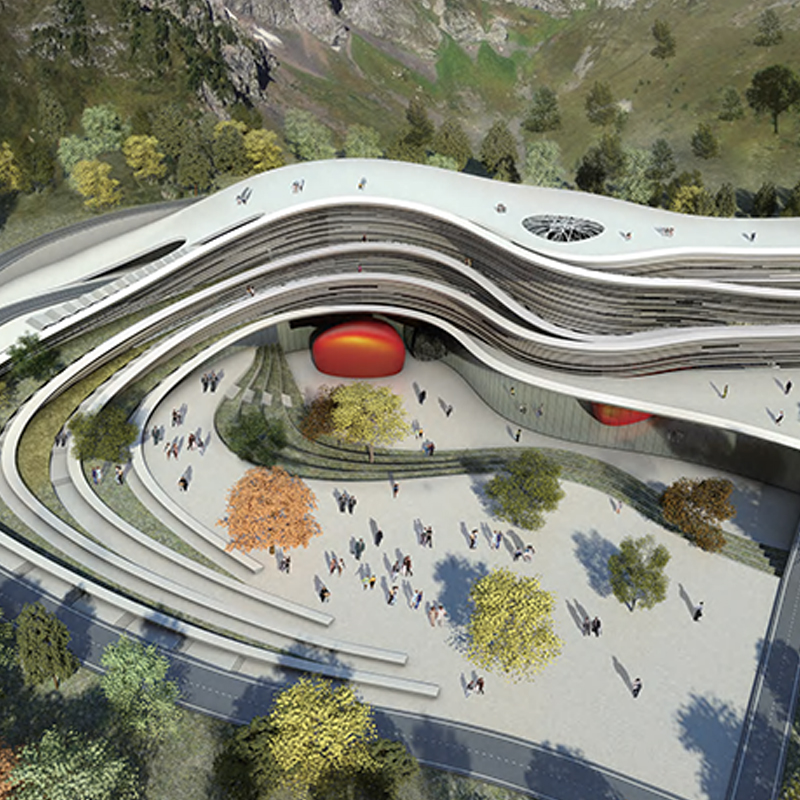
Traditional framing relies entirely on vertical columns and horizontal beams. This rigid grid cannot support continuous curvature efficiently. To support a highly customized Museum Steel Structure, engineers must shift to a diagrid (diagonal grid) system. Diagrids represent a fundamental evolution in how we manage structural loads.
Diagrids distribute structural loads across multiple intersecting diagonal pathways. They form a robust, inherently stable triangular network. This specific feature enables the massive column-free interior space necessary for immersive museum exhibits. Vertical loads travel diagonally down the building skin. This transfers the structural burden away from the interior footprint entirely.
This structural framework significantly optimizes raw steel tonnage. It eliminates bulky vertical columns from the internal floor plan. Material efficiency looks great on paper. However, this raw material savings is sharply counterbalanced by the increased complexity of the nodal connections. Every intersection where diagonal beams meet requires a highly customized steel node.
We must acknowledge the trade-offs honestly through a skeptic's lens. While diagrids save on raw material weight, they dramatically increase hidden execution costs. They require massive engineering hours to mathematically model. Custom node fabrication becomes highly intensive and expensive. You also face strict localized welding inspections at every unique joint. Ultrasonic testing and radiography become mandatory for structural safety validation.
Below is a chart summarizing the fundamental differences between framing approaches:
Evaluation Criteria | Traditional Orthogonal Framing | Diagrid Structural Framework |
|---|---|---|
Load Distribution | Vertical transfer via columns and horizontal beams | Multi-pathway diagonal exterior network |
Interior Space Impact | Heavily interrupts floorplans with vertical columns | Creates 100% column-free interior environments |
Nodal Complexity | Relatively low (standardized, repeatable connections) | Extremely high (unique, parametrically generated nodes) |
Geometric Flexibility | Limited to basic rectangular or stepped forms | Enables extreme free-form and continuous curvature |
Moving beyond basic 3D modeling is essential for modern complex architecture. Standard CAD simply fails in these non-linear environments. Parametric scripting becomes absolutely mandatory. Engineers use algorithmic scripts to generate unique nodes automatically based on strict mathematical rules. If the architect tweaks the exterior curve slightly, the script automatically recalculates the angles of thousands of underlying steel connections.
You must coordinate the primary structural skeleton alongside intricate MEP systems. You must also align it perfectly with the secondary facade framing. We heavily evaluate software integrations like Tekla Structures to achieve millimeter-level accuracy. This extreme precision is required for zero-tolerance geometric alignments. The margin for error on a curved facade approaches zero.
A centralized Building Information Modeling (BIM) model serves as the single source of truth. It prevents disastrous and costly on-site rework. The software simulates the exact assembly sequence digitally before a single piece of steel is ever cut. Everyone works from identical data. The architect, structural engineer, and fabricator view the exact same digital twin constantly.
Without high-fidelity BIM, resolving node clashes becomes an on-site nightmare. A clash occurs when a steel beam physically intersects an HVAC duct in the model. Advanced BIM runs automated clash detection protocols daily. It highlights spatial conflicts instantly. Engineers resolve these digital clashes in the office. This avoids halting expensive crane operations on the actual construction site.
Designing a brilliant structure on a monitor is only half the battle. Node complexity dictates the true manufacturing difficulty. You face the daunting reality of fabricating thousands of unique, non-repeating steel connections. We strongly evaluate the CNC milling and robotic welding capabilities of potential fabrication partners. Human welders alone cannot achieve the microscopic tolerances required for non-linear diagrid nodes.
Managing the physical supply chain requires military-level logistical precision. You must deliver custom components sequentially to a highly constrained urban site. We rely heavily on QR and RFID component tracking systems. Every steel piece receives a digital tag. This tracking ensures the exact right steel node arrives at the precise hour needed for continuous sequential erection.
On-site teams face severe physical erection challenges. They must balance the need for temporary support structures (falsework) against tight site limitations. You also carry the intense risk of cumulative tolerance drift. If one node is slightly off by two millimeters, the entire assembly sequence can quickly derail over a hundred-foot span. The final piece simply will not fit.
To actively mitigate assembly risks, structural teams implement the following strict protocols:
Implement localized 3D laser scanning during factory fabrication to verify node geometry before shipping.
Scan each newly erected steel section on-site daily to catch tolerance drift immediately.
Utilize just-in-time delivery systems matched precisely to the crane's daily lifting schedule.
Deploy adjustable temporary falsework that allows micro-adjustments during the final welding phases.
Choosing the right structural partner makes or breaks your highly complex project. You need a rigorous shortlisting logic. First, conduct a strict BIM maturity assessment. Do not settle for impressive conceptual design capabilities alone. Demand hard evidence of automated fabrication outputs. They must prove they can generate NC (Numerical Control) files directly from their structural models.
Next, assess their cross-disciplinary coordination provenance. Examine their historical ability to manage the critical project triangle: Architect, Structural Engineer, and Steel Fabricator. They must demonstrate success operating under tight parametric constraints. Ask for specific case studies where they resolved massive digital clashes prior to physical construction.
Look carefully for transparent risk mitigation protocols. They should offer clear, documented frameworks regarding raw material testing and independent node inspections. They must also present contingency plans for inevitable assembly deviations. A mature engineering partner assumes problems will occur and plans recovery steps accordingly.
As an immediate next-step action, initiate a pre-construction constructability review. Build a localized physical structural mockup of the most complex nodal intersection. Do this before committing major capital to full-scale fabrication. This physical test proves whether the digital model actually translates into a weldable, buildable reality.
The Museum of the Future proves that modern structural boundaries are defined entirely by digital coordination and advanced manufacturing logistics. Achieving gravity-defying, column-free spaces is no longer a guessing game. It is a highly engineered certainty driven by parametric algorithms.
Here are your crucial takeaways and next steps:
Audit your current engineering partners specifically for direct-to-fabrication data workflows.
Mandate comprehensive 4D BIM simulations prior to breaking ground on any free-form geometry.
Allocate dedicated early-stage budget for physical mockups of the most complex structural nodes.
Prioritize RFID supply chain tracking to eliminate crane downtime during constrained urban builds.
Executing a custom architectural framework requires a partner whose digital agility perfectly matches their heavy fabrication capabilities. You cannot separate the software from the welding bay. Contact our structural engineering team today to schedule a detailed constructability assessment and comprehensive BIM coordination review for your next ambitious architectural project.
A: It utilizes a complex, non-repeating diagrid steel framework that entirely eliminates internal columns. This iconic building relies intensely on advanced parametric modeling to ensure absolute structural integrity across its curved, torus-shaped geometry.
A: A diagrid system provides exceptionally high structural rigidity while allowing for completely free-form geometric facades. Crucially, it distributes load paths efficiently to create the massive, uninterrupted interior spaces necessary for large-scale immersive exhibitions.
A: The biggest risks include cumulative tolerance errors during the physical assembly process. Supply chain sequencing failures can halt progress entirely. Furthermore, clash discrepancies between the intricate steel skeleton and heavy MEP systems pose major rework threats.
A: Focus sharply on their advanced BIM capabilities and data maturity. Examine their specific process for managing fabrication tolerances of unique connection nodes. Finally, verify their historical track record of successfully executing seamless 3D-to-field supply chains.


